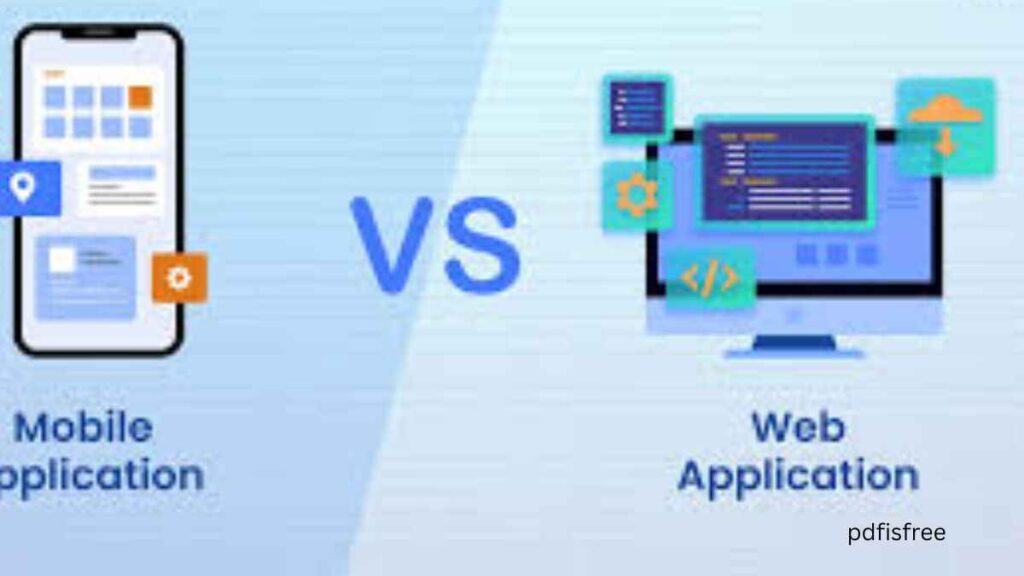
Comparing mobile apps vs web: The use of PDF files is a part and parcel of digital work and communication. PDFs are ubiquitous since schoolwork and business contracts, as well as scanned receipts and eBooks, all use them. As the need of PDF editing, conversion, signing, compression, and collaboration grows, there has been the emergence of two major types of tools:
Top tools for PDF editing vs PDF conversion — which to use when
Mobile PDF Apps -The apps are installed on tablets and smartphones.
Web-Based PDF Tools- PDFs are used via a web browser.
They both have merits and demerits and the selection of the appropriate one depends on your demands, gadget, your work situation and the workflow.
This line-by-line comparison will attempt to compare both of these and provide some important differences and reasons why each should be used at a particular time.
What Are Mobile PDF Apps?
Mobile PDF applications are programs that are installed on the phone or tablet devices. They offer PDF features that are touch-friendly and also offline.
Examples Include:
- Adobe Acrobat Reader Mobile
- Foxit PDF
- Xodo PDF Reader & Editor
- PDFelement
- WPS Office PDF module
Mobile applications tend to have such functions as annotation, signing, filling forms, and simple editing.
What Are Web-Based PDF Tools?
Online PDF software is browser-based. You can upload or import a PDF file, do things, and download the outcomes without having to install specific applications.
Examples Include:
- Smallpdf
- iLovePDF
- PDF24 Tools
- PDF2Go
- TinyWow
Web tools are accessible using a device that has a browser i.e. desktops, laptops, tablets as well as mobiles.
Essential Disagreements between Web-based tools and Mobile applications.
Feature
- Mobile PDF Apps
- Web-Based PDF Tools
- Installation
- Installed on device
- No installation required
- Access
- Offline support
Requires internet (mostly)
Features
- Often deep editing
- Broad tool variety
- Device Dependency
- Works on that device
- Works everywhere
Storage
- Local + cloud
- Cloud-based uploads
- Speed
- Quick local processing
- Dependent on internet speed
- Security
- Local control
- Depends on website security
- Updates
- App updates required
- Instant updates
The benefits of Mobile PDF Apps.
1. Offline Accessibility
The mobile PDF applications usually do not require an internet connection. This is highly applicable when:
- Traveling
- Working in remote areas
- Networks are unstable
- Offline access makes sure that your PDF work is not interrupted.
2. Deep Native Integration
Mobile PDF applications are used with the device functionality such as:
- Camera (for scanning)
- Local storage
- File managers
- Touch and stylus input
It simplifies and accelerates the process of scanning hard copies and making notes on them.
3. Annotation and Markup Tools
Mobile PDF apps usually have:
- Highlighting
- Comments
- Drawing (s drawing with finger or stylus)
- Stamp and signature tools
These are useful tools to students, professionals and reviewers.
4. Higher Performance on Large Files.
Larger PDFs can be easier to handle in applications since they can operate files on the device itself, without transferring them to some server.
5. Security and Privacy
Mobile apps are capable of local storage and password security without the operation of data dealing with third party servers. This is significant in the case of a confidential or sensitive document.
Mobile PDF Apps Shortcomings.
1. Minimal Higher Conversion.
Conversion of PDF to Excel or Word (very few apps do that on mobile) is also restricted in many mobile apps in contrast to web tools.
2. App Size
Installation of various applications may consume storage space.
3. Feature Restrictions
Premium upgrades might be needed to include such advanced capabilities as batch processing, OCR on any file, or complicated editing.
The benefits of PDF Web-Based Tools.
1. No Installation Needed
Web tools can be used on any browser enabled device. This is perfect when you:
- Use of a common or sharing device.
- Don’t want to install apps
- Need quick one-time tasks
One can just sit down before a computer and get to work.
2. Wide Variety of Tools
Web platforms tend to provide more PDF capabilities such as:
- Merge/split
- Export/Import Word, Excel, PPT.
- Compress large files
- Turn URLs or cloud storage.
- Online OCR
- eSignatures
- This renders workflow tasks more flexible with the help of web tools.
3. Cloud Integration
Cloud storage such as: is frequently combined with web tools such as:
- Google Drive
- Dropbox
- OneDrive
This will enable the importing and exporting with ease to your workflow.
4. Rapid Updates
As changes occur on the server side, web tools update features automatically right after the changes occur with no user intervention.
Drawbacks of Internet PDF Resources.
1. Internet Dependence
The web tools are mostly dependent on a stable internet connection. When the internet is slow or unavailable, it takes a long time to achieve the task or even fails.
2. Privacy Concerns
Posting confidential files on web applications could be associated with privacy threats. Third party server can be a problem to confidential information even when the files are removed once processed by the site.
3. Performance Disk File Size Performance.
Big files might take time to upload and waste bandwidth. This may be an issue of limited data plans or slow networks.
Comparison of features Mobile vs Web tools.
1. Editing PDFs
Mobile Apps: Ideal when it comes to annotation, signing, notes, highlighting and simple text edits.
Web Tools: Reasonable to rearrange pages, add/ delete, and to some extent edit.
When to use:
To touch-based editing on the go → Mobile App.
To reorganize the contents of deep page or complicated edits → Web tool (e.g., Sejda online editor)
2. Converting PDFs
Mobile Apps: Basic PDF to Word or vice versa.
Web Tools: Support more conversions, such as PDF to Excel/PPT conversions and image conversions.
When to use:
Detail editing in Word or Excel to the Web Tool (e.g. Smallpdf, iLovePDF)
3. Merging and Splitting
Mobile Apps: Merge/Split is now supported by some mobile editors.
Web Tools: Provide drag-and-drop choice of flexibility.
When to use:
Page rearrangement heavy-weight page rearrangement Web Tool
Fast parting jobs on the machine → Mobile App.
4. Compressing Large PDFs
The process of compressing decreases file size in order to be shared or uploaded.
Mobile Apps: Basic compression and reduced choice.
Web Tools: Introduce customized compression levels.
When to use:
Require the smallest file size Web Tool
Rapid easy squeeze on gadget to Mobile App.
5. OCR (Text Recognition)
OCR translates scanned images to text, which can be selected.
Mobile Applications: There are numerous apps where OCR (a quick scan) is used.
Web Tools: Are frequently equipped with superior OCR processing and format processing.
When to use:
Scanned document OCR to Web Tool + Complex.
Fast scanning and text recognition on-the-fly → Mobile App.
Practical Use Cases
Students
Underline PDF text Mobile App
Downloading lecture PDF to cloud → Web Tool.
PDF to Word conversion to Web Tool.
Business Professionals
On-the-fly signature of contracts → Mobile App.
Combining project reports + Web Tool.
File compression to email web tool or application.
Remote Workers
Offline PDFs during meeting to use → Mobile App.
Team edit web tool to collaborate with.
Designers and Creators
Add branding or graphics to PDFs → Canva or other Web Tool.
Annotate drafts → Mobile App
Security and Privacy Issues.
Mobile Apps
Keep files in-house (greater privacy).
Use device encryption.
Most functions did not require any internet.
Web-Based Tools
Data is deposite on servers.
Biased websites remove files after processing.
The privacy policy of any tool must be read before sensitive documents are uploade.
Cost and Subscription
There are numerous pay and free options of tools, mobile and web:
Mobile Apps: Mobile applications are usually free with a subscription fee charge for premium services.
Web Tools: They are normally free until they reach a limit on usage after which a subscription is need.
The decision between the two will be based on the frequency of use of advanced features.
Conclusions: What to Use?
Use Mobile PDF Apps When:
- You are on the go
- Need offline access
- You would like annotation and device signing.
- You prefer local privacy
- Use Web-Based PDF Tools When:
- You must have strong conversion capabilities.
- Are operating either a desktop or a laptop.
- You need sophisticated operations (OCR, merge, compress).
- You would like to have direct support with cloud storage.
Conclusion
Mobile applications as well as web-based PDF tools occupy a prominent position in the contemporary document processes. Mobile applications are convenient, can be used without connection, and can be annotated by touch. Web tools are also bright in terms of the strong conversion possibilities, diversity of features, and versatility.
It is up to you and what you need to do. A hybrid between the two tools, which is to apply both tools according to a task, is the most productive and efficient in the eyes of many users.